Groningen, the Netherlands (2021).
Visual rhyme is usually discussed as something that happens between photographs — a repetition that emerges when you place two images side by side, in a series or across a spread. But the rhyme can just as easily unfold within a single photograph, which makes it subtler but no less powerful. There, it doesn't happen because the viewer flips back and forth, but in a single glance: the brain recognizes a repetition — of form, colour, or gesture — before it can name what exactly rhymes.
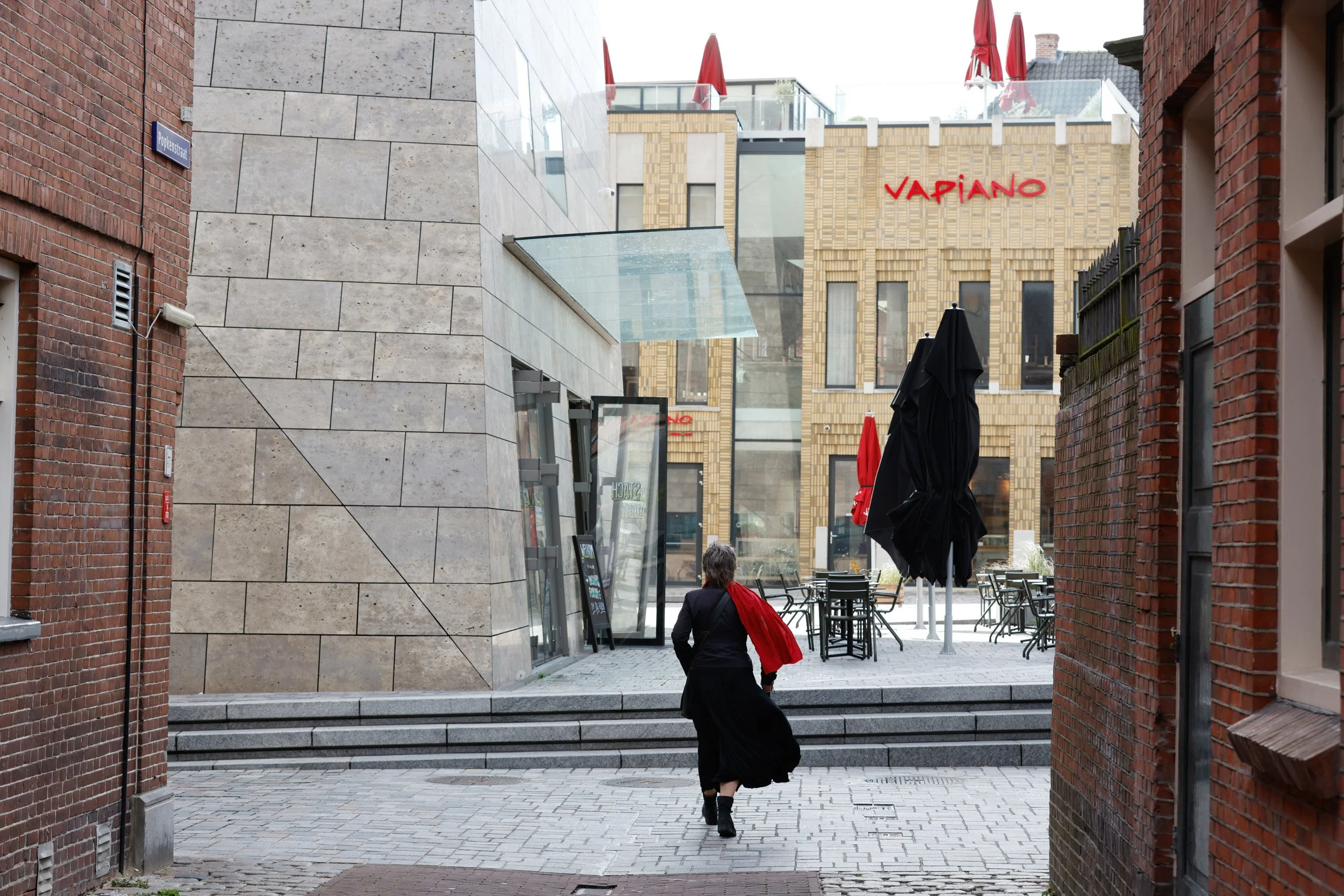
Take the photo of the woman walking toward the Forum in Groningen. The rhyme here lies mainly in colour, and it plays out on two levels at once. Her red scarf, billowing as she moves, finds an echo in the red umbrellas on the rooftop terrace and in the red letters of the Vapiano sign — red appearing three times, scattered across the composition, answering each other across the distance. At the same time, her black coat rhymes with the closed black parasol in the middle of the frame: two dark, vertical shapes that are almost related in silhouette, as if the parasol were a still, motionless counterpart to her dynamic, moving figure.
What makes this photo interesting is that the rhyme isn't designed in the classical sense — you can't direct a passer-by, a billowing scarf, or the exact position of a parasol. It's chance that plays out here in an almost magical way, a moment in which every element in the frame falls into perfect alignment with the others, what Henri Cartier-Bresson called The Decisive Moment. And that's exactly where this kind of visual rhyme touches on what drives my work: the tension between order and chance, between what you go looking for with your camera and what presents itself unasked. The image "works" without me having had any control over the situation, other than pressing the shutter at the right moment.
Either way, it's the newest addition to the project What were you thinking? Can you come up with a touching or funny thought to go with it?
Beeldrijm wordt meestal besproken als iets tussen foto's — een herhaling die ontstaat wanneer je twee beelden naast elkaar legt, in een serie of op een spread. Maar het rijm kan zich net zo goed binnen één foto voltrekken, wat het subtieler maar minstens even krachtig maakt. Daar gebeurt het niet doordat de kijker bladert of terugkijkt, maar in één oogopslag: het brein herkent een herhaling — van vorm, kleur of gebaar — voordat het kan benoemen wát er precies rijmt.
Neem de foto van de vrouw die richting het Forum in Groningen loopt. Het rijm zit hier vooral in kleur, en het speelt zich af op twee niveaus tegelijk. Haar rode sjaal, die opwaait terwijl ze zich voortbeweegt, vindt een echo in de rode paraplu's boven op het dakterras en in de rode letters van het Vapiano-logo — drie keer rood, verspreid over de compositie, die elkaar op afstand beantwoorden. Tegelijkertijd rijmt haar zwarte jas met de dichtgeklapte zwarte parasol middenin het beeld: twee donkere, verticale vormen die qua silhouet bijna verwant zijn, alsof de parasol een stille, onbeweeglijke tegenhanger is van haar dynamische, bewegende gestalte.
Wat deze foto interessant maakt, is dat het rijm niet ontworpen is in de klassieke zin — je regisseert geen voorbijganger, geen wapperende sjaal, geen precieze positie van een parasol. Het is toeval dat hier op een haast magische wijze uitpakt, een moment waarop alle elementen in het beeld perfect in samenhang met elkaar zijn, door Henri Cartier-Bresson aangeduid als The Decisive Moment. En dat is precies waar dit type beeldrijm raakt aan wat mijn werk drijft: die spanning tussen orde en toeval, tussen wat je zoekt met je camera en wat zich ongevraagd aandient. Het beeld “klopt” zonder dat ik enige controle over de situatie had, behalve op het juiste moment af te drukken.
Hoe dan ook, het is de nieuwste toevoeging aan het project What were you thinking? Kun jij er een een ontroerende of grappige gedachte bij bedenken?