Sounds rather philosophical and scientific. Explain. What kind of concepts are these?!
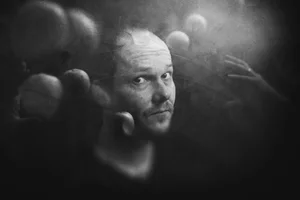
Quarantine. Surhuisterveen, the Netherlands (2020). From the series “2020”. C-print on alu-dibond, based on cyanotype, 30 x 20, edition of 10 + 1 AP.
Gladly! Order and chaos are usually seen as opposites, but they never exist separately from each other. You can only see chaos against a background of order: without a grid, a displaced dot is just a dot. At the same time, order only acquires meaning once time threatens to turn it upside down. A completely ordered image doesn’t hold my interest for long, and neither does a completely chaotic one. What lies in between, that is what I find interesting.
But where does that transition lie?
Well, when does order turn into chaos? I think that depends not only on who is looking, but also on how and when you look.
What my wife sees as a tidy desktop is utter chaos to me. And the reverse is just as true: I don’t really see the point of vacuuming every week, since the robot vacuum usually does a fine job. My wife begs to differ.
The same person can also look in two different ways. Walking down the Kalverstraat in Amsterdam, it’s usually a hustle and bustle. But as soon as you fly over that same part of the city from Schiphol, you see a complex yet ordered pattern of streets, lights, people and cars.
So paying close attention helps?
Uh, yes. Did I mention that I spent almost thirty years doing scientific research on the temporal dynamics of selective attention?
Attention helps us bring order to the abundance of information around us. Our brains can only process a small part of it at any one time. Only a fraction of what we perceive reaches our awareness. What falls outside the spotlight, we quickly experience as noise. But that spotlight isn’t everywhere at once: someone who has just noticed something may miss what happens a few hundred milliseconds later, even though it’s right there.
What we experience as chaos therefore depends not only on how we look, but also on when we look. The world around us is constantly changing, while our attention can only ever follow part of it.
Ah. Order and chaos as a function of time.
Exactly. Perhaps chaos is simply order we can’t (yet) read. We’re missing a lot: knowledge, overview, control. And time.
And what does that have to do with photography?
A lot. A photograph gives chaos a frame and a moment: a brief order, even if that too is temporary. You choose what falls inside the frame and what stays outside. You capture something, but that doesn’t stop time. What you photograph keeps changing, eventually decays or disappears.
And time isn’t in the images, but between them.
I’m going to dig into that over the coming period. The plan is to make a series of diptychs together with Daan de Beer: two images that together form one whole. Each week, one of us starts with an image of order, after which the other responds with an image of chaos. We assist each other in making every image, and we swap roles every week.
Ah, a new collaboration!
Yes, and not just for the company. A photo studio offers complete control, and I’m rather fond of that, of course. But that very control also limits the room for spontaneity and surprise.
Staged chaos is difficult, if not impossible. As soon as you devise chaos and try to give it shape, it’s already a form of order again. Real chaos therefore requires you to hand over control: to gravity, to time, to chance, or to someone else.
Orde & chaos als functie van de tijd
Klinkt nogal filosofisch en wetenschappelijk. Leg uit. Wat zijn dat voor concepten?!
Timefold II. Surhuisterveen, the Netherlands (2019).
C-print on alu-dibond, 60 x 90, edition of 10 + 1 AP.
Graag! Orde en chaos worden meestal als tegenpolen van elkaar gezien, maar ze bestaan nooit los van elkaar. Chaos zie je alleen tegen een achtergrond van orde: zonder raster is een verschoven punt gewoon een punt. Tegelijk krijgt orde pas betekenis zodra de tijd haar dreigt overhoop te halen. Een volkomen geordend beeld blijft me niet lang boeien, en een volkomen chaotisch beeld evenmin. Wat daartussen zit, dát vind ik interessant.
Maar waar zit die overgang dan?
Tja, wanneer verandert orde in chaos? Dat hangt denk ik niet alleen af van wie er kijkt, maar ook van hoe en wanneer je kijkt.
Wat voor mijn vrouw een geordende desktop is, is voor mij volstrekte chaos. Andersom geldt hetzelfde: ik zie de noodzaak van wekelijks stofzuigen niet zo, de robotstofzuiger doet dat doorgaans prima. Mijn vrouw denkt daar anders over.
Ook dezelfde persoon kan op twee manieren kijken. Als je door de Kalverstraat in Amsterdam loopt, is het meestal een drukte van jewelste. Maar zodra je vanaf Schiphol over hetzelfde gedeelte van de stad vliegt, zie je een complex, en toch geordend patroon van straten, verlichting, mensen en auto's.
Dus aandachtig kijken helpt?
Uuh, ja. Had ik al verteld dat ik bijna dertig jaar wetenschappelijk onderzoek heb gedaan naar de tijdsdynamiek van selectieve aandacht?
Aandacht helpt ons orde aan te brengen in de overvloed aan informatie om ons heen. Onze hersenen kunnen immers maar een klein deel daarvan tegelijk verwerken. Slechts een fractie van wat we waarnemen, dringt bewust tot ons door. Wat buiten de spotlight valt, ervaren we al snel als ruis. Maar die spotlight is niet overal tegelijk: wie net iets heeft opgemerkt, mist soms wat een paar honderd milliseconden later gebeurt, ook al is het er gewoon.
Wat we als chaos ervaren, hangt dus niet alleen af van hoe we kijken, maar ook van wanneer we kijken. De wereld om ons heen verandert voortdurend, terwijl onze aandacht steeds maar een deel daarvan kan volgen.
Ah. Orde en chaos als functie van de tijd.
Precies. Misschien is chaos eigenlijk gewoon orde die we (nog) niet kunnen lezen. We missen een hoop: kennis, overzicht, controle. En tijd.
En wat heeft dat met fotografie te maken?
Veel. Een foto geeft de chaos een kader en een moment: even orde, al is ook dat tijdelijk. Je kiest wat binnen het kader valt en wat erbuiten blijft. Je legt iets vast, maar daarmee houd je de tijd niet tegen. Wat je fotografeert, blijft veranderen, raakt uiteindelijk in verval of verdwijnt.
En de tijd zit niet in de beelden, maar ertussen.
Daar ga ik de komende tijd eens lekker mee aan de slag. Het plan is om samen met Daan de Beer een serie tweeluiken te maken: twee beelden die samen één geheel vormen. Elke week begint één van ons met een beeld van orde, waarna de ander daarop reageert met een beeld van chaos. We assisteren elkaar bij het maken van elk beeld en wisselen elke week van rol.
Ah, een nieuwe samenwerking!
Ja, en niet alleen vanwege de gezelligheid. Een fotostudio biedt volledige controle. En daar ben ik natuurlijk nogal van. Maar juist die controle beperkt ook de ruimte voor spontaniteit en verrassing.
Geënsceneerde chaos is lastig, zo niet onmogelijk. Zodra je chaos bedenkt en probeert vorm te geven, is het alweer een vorm van orde. Echte chaos vraagt dan ook dat je de controle uit handen geeft: aan de zwaartekracht, aan de tijd, aan het toeval of aan een ander.